
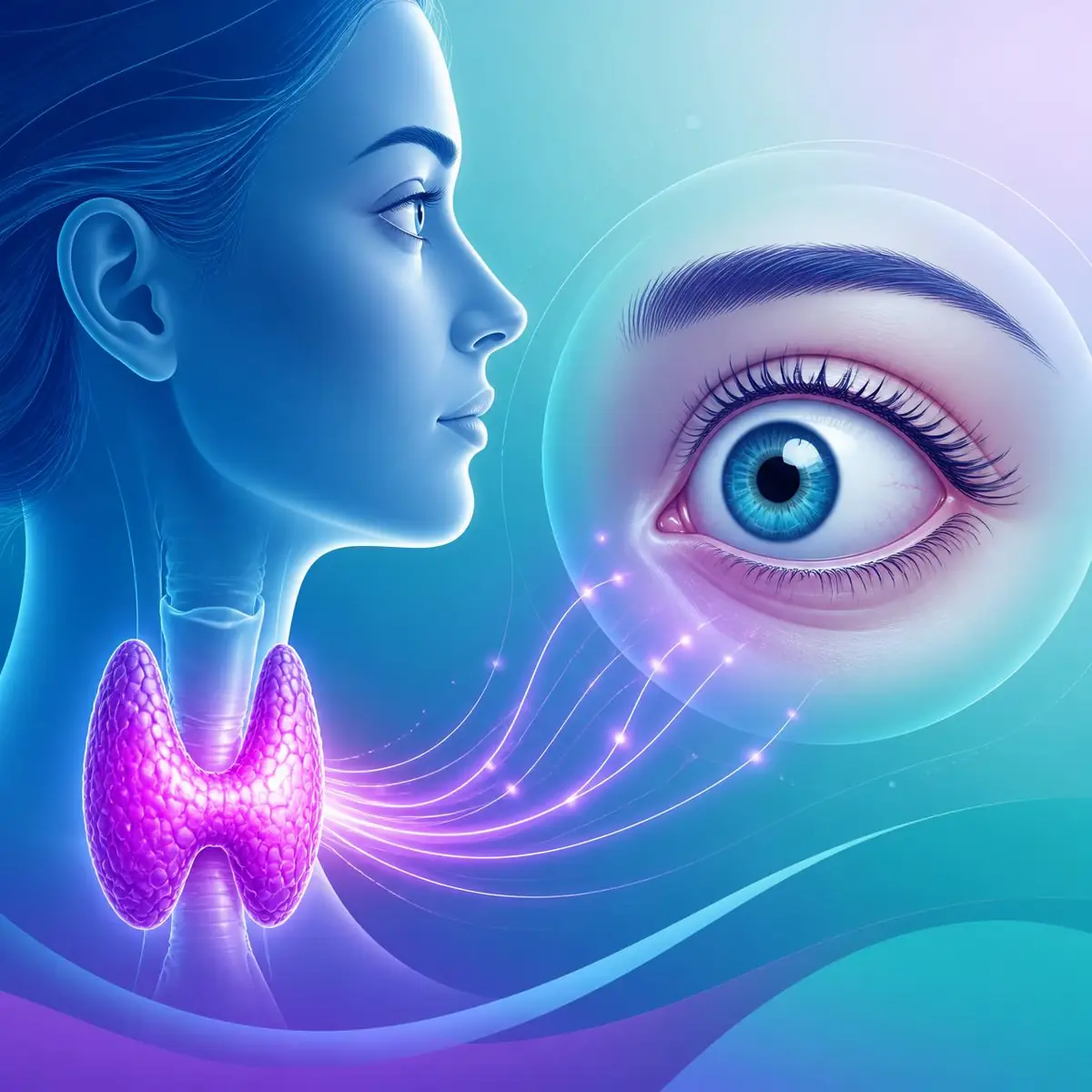
Short answer: Thyroid eye disease is an autoimmune condition linked to Graves’ disease that inflames the muscles and fat behind the eye. It can cause bulging eyes, retracted eyelids, dry eye and double vision. Many cases are mild; moderate or severe ones need an ophthalmologist and an endocrinologist, and vision loss is an emergency [1].
Key points
- It occurs mainly in people with Graves’ disease; usually, in 8 of 10 cases the eye disease and the thyroid problem appear less than 2 years apart.
- Quitting smoking and keeping thyroid levels stable matter most.
- Most cases are mild and managed with lubricants and monitoring.
- Active inflammation has medical treatments; once it settles, surgery corrects what remains.
- If you lose vision or colors look washed out, go to urgent care today [1, 2].
Warning signs: See when to go to the emergency room
What is thyroid eye disease?
It is also called Graves’ orbitopathy. The immune system attacks connective tissue around the eye muscles and orbital fat, causing swelling, eyelid retraction, bulging (proptosis), double vision and, rarely, optic nerve compression [1].
Who gets thyroid eye disease and why?
Up to 4 in 10 people with Graves’ disease develop thyroid eye disease. Moderate-to-severe disease occurs in about 6% and sight-threatening disease in about 0.5%. Smoking, unstable thyroid function, radioactive iodine treatment, male sex and age over 50 raise risk or severity. Smoking is the most important one you can change. Antibodies against the thyroid-stimulating hormone (TSH) receptor are almost always present in the blood and help confirm Graves’ disease [1, 2, 9].
What are the symptoms of thyroid eye disease?
- Retracted upper eyelid, giving a staring look: more than 9 in 10 patients.
- Bulging eyes, the second most common sign.
- Red, swollen lids and conjunctiva; pain behind the eye or on side gaze.
- Dry eye, gritty feeling, light sensitivity.
- Double vision, mostly looking up or to the side [1, 2].
How does thyroid eye disease progress?
There is an active inflammatory phase, a short static phase and an inactive phase, usually reached 12 to 18 months after onset. In the inactive phase the inflammation improves, but bulging and eye-movement problems can persist in up to half of patients who do not receive treatment [1].
How is thyroid eye disease diagnosed?
The ophthalmologist checks vision, colors, eye movements, eyelid position and how far the eye protrudes. To tell whether the disease is active, a list of 7 signs of inflammation (Clinical Activity Score, CAS) is used; 3 or more means the disease is considered active. If in doubt, the exam is repeated after 4 to 6 weeks. Depending on the case, laboratory or imaging tests are ordered before starting or continuing treatment [1].
How is thyroid eye disease treated?
Treatment depends on whether the disease is active and how severe it is. It is decided by an endocrinology and ophthalmology team [1].
Medical (non-surgical) treatments
- Local measures: artificial tears, night gel and prisms (special lenses for double vision); smoking cessation.
- Selenium for 6 months, in mild disease.
- Intravenous corticosteroids, in active moderate-to-severe disease.
- Biologic therapy: teprotumumab (FDA-approved in the US since January 2020, not yet available in Mexico, Oct 2026) and, as second-line options, rituximab or tocilizumab.
- Orbital radiotherapy, in selected cases with progressive double vision [1, 2].
- Steroid injection (triamcinolone or betamethasone) in the muscles that lift the eyelid, for eyelid retraction; usually 2 to 4 monthly sessions; efficacy is variable [3–5, 8].
- Botulinum toxin injection for eyelid retraction: it works in 2 to 3 days and lasts about 6 weeks; combined with the steroid it acts faster; both injections can be used during the active phase [6–8].
Which symptoms and signs can improve with medication
- Burning, dry eye and tearing: artificial tears and night gel.
- Redness, swelling and pain of the active phase: intravenous corticosteroids.
- Bulging and double vision of the active phase: teprotumumab, which is not yet available in Mexico (Oct 2026) [1, 2].
When is surgery done?
Rehabilitative surgery is done when disease is inactive and thyroid function has been stable, usually 4 to 6 months, depending on each case. It is staged: first the orbit so the eye returns to its position, then the muscles to align the gaze, and finally the eyelids. Not everyone needs all three. Occasionally an urgent decompression is needed, when vision drops because of optic nerve compression [1, 2].
- Orbital decompression: gives the eye more room by removing fat or parts of the bone. Its risks include cerebrospinal fluid leak, oscillopsia (shaky vision), cheek numbness and new double vision.
- Strabismus surgery: aims to restore single vision when looking straight ahead.
- Eyelid surgery: corrects the retraction and the protruding fat [1, 2].
Dr. Diener performs orbital decompression and eyelid surgery; strabismus surgery is done together with strabismus specialists. He also offers local TED treatments such as steroid and botulinum toxin injections, among others.
When to go to the emergency room
See an ophthalmologist immediately for reduced vision, washed-out colors, a blind spot, rapidly worsening vision, severe pain on eye movement, or an eye that will not close and becomes ulcerated [1].
Optic neuropathy occurs in 5 to 10 of every 100 cases and is treated urgently with high-dose intravenous corticosteroids; if vision does not improve, orbital decompression is considered [1, 2].
Prior evaluation, alternatives and risks
Before any treatment, a complete evaluation and clinical history are carried out, and with them the right treatment is chosen for each patient. In mild cases there is always the alternative of monitoring and using local measures. Each treatment has its own risks and benefits [1, 2].
FAQ
Is thyroid eye disease curable, or does it go away on its own?
Why do the eyes look bulging or different with thyroid disease?
Does thyroid eye disease only occur with an overactive thyroid?
Does quitting smoking help?
Can radioactive iodine worsen it?
When should I see an ophthalmologist?
More information: orbital surgery · recovery tips · insurance providers.
Signed: Dr. Sebastián Diener, ophthalmologist and oculoplastic surgeon; professional license 11031816 (ULSA); specialty license 12354611 (UNAM); certified by the Mexican Council of Ophthalmology. Last medical review: October 19, 2026.
References
View references
According to PubMed.
- Burch HB, Perros P, Bednarczuk T, et al. Management of Thyroid Eye Disease: A Consensus Statement by the ATA and ETA. Thyroid. 2022;32(12):1439-1470. PMID 36480280. DOI
- Markantes GK, Effraimidis G, Karapanou O, et al. How to manage thyroid eye disease: recent advances – a narrative review. Drugs Context. 2026;15. PMID 42741468. DOI
- Badjrai RA, Eldinia LR, Anandi L, et al. Triamcinolone injection in the treatment of lid retraction for thyroid-associated ophthalmopathy: a systematic review. Eur J Ophthalmol. 2025;35(1):69-76. PMID 38751133. DOI
- Awad RA, Abo-Ghadir AA, Hussien MS, et al. Local betamethasone versus triamcinolone injection in management of thyroid eye disease-related upper eyelid retraction with proptosis. Ophthalmic Plast Reconstr Surg. 2025;41(3):273-279. PMID 39588844. DOI
- Barlatay JMG, Boza CP, Basso TO, et al. Adverse effects associated with peribulbar injection of triamcinolone for the treatment of thyroid eye disease: a retrospective case series. Arq Bras Oftalmol. 2023;86(5):e20230063. PMID 35544933. DOI
- Huang Z, Xu M, Zhang W, Song X. Triamcinolone acetonide and botulinum toxin A for upper eyelid retraction in thyroid-associated ophthalmopathy. Sci Rep. 2025;15(1):5103. PMID 39934153. DOI
- Eckstein A, Dekowski D, Führer-Sakel D, Berchner-Pfannschmidt U, Esser J. Endokrine Orbitopathie [Graves’ ophthalmopathy]. Ophthalmologe. 2016;113(4):349-364. PMID 27059986. DOI
- Samia-Aly E, Penarrocha S, Ramsewak S, et al. Thyroid eye disease: established and emerging therapies. Best Pract Res Clin Endocrinol Metab. 2026;40(5):102154. PMID 42629268. DOI
- Seo S, Sánchez Robledo M. Usefulness of TSH receptor antibodies as biomarkers for Graves’ ophthalmopathy: a systematic review. J Endocrinol Invest. 2018;41(12):1457-1468. PMID 30194634. DOI
General information; it does not replace a medical evaluation.